Photonic neurons integrate sensing, memory and compute in a single architecture
Tags Hardware · AI / ML
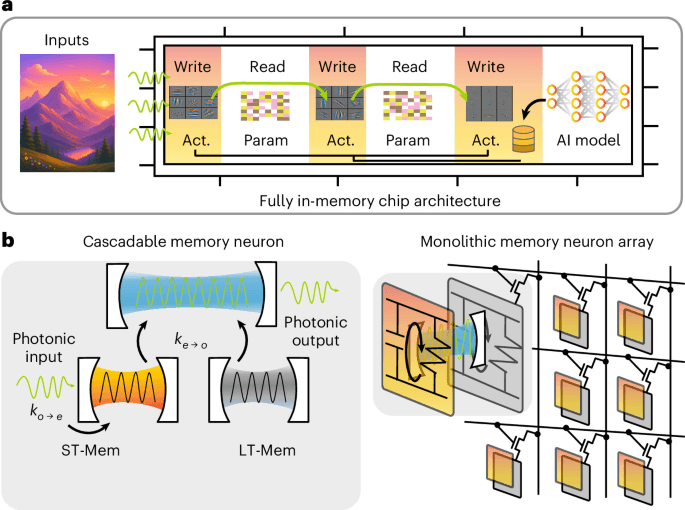
A study titled 'Fully in-memory photonic computing,' summarized in a Nature Sensors research briefing published Oct 2, 2026, describes a silicon photonic architecture that integrates sensing, memory and computation within artificial neurons. The design uses optoelectronic coupling and photonic cascading to retain both network parameters and intermediate signals in memory, reducing the energy cost of shuttling data between memory and processors. The work was published in Nature Sensors (DOI 10.1038/s44460-026-00123-2).
Technical significance
In-memory photonic computing targets the dominant energy cost in modern accelerators — moving data between memory and compute — by keeping parameters and intermediate signals in the optical domain. If the approach scales beyond laboratory demonstrations, it could inform a class of low-power neuromorphic sensors that process signals at the point of capture. The result is a research milestone rather than a product, and its practical impact depends on manufacturability and integration with existing silicon photonics foundries.